
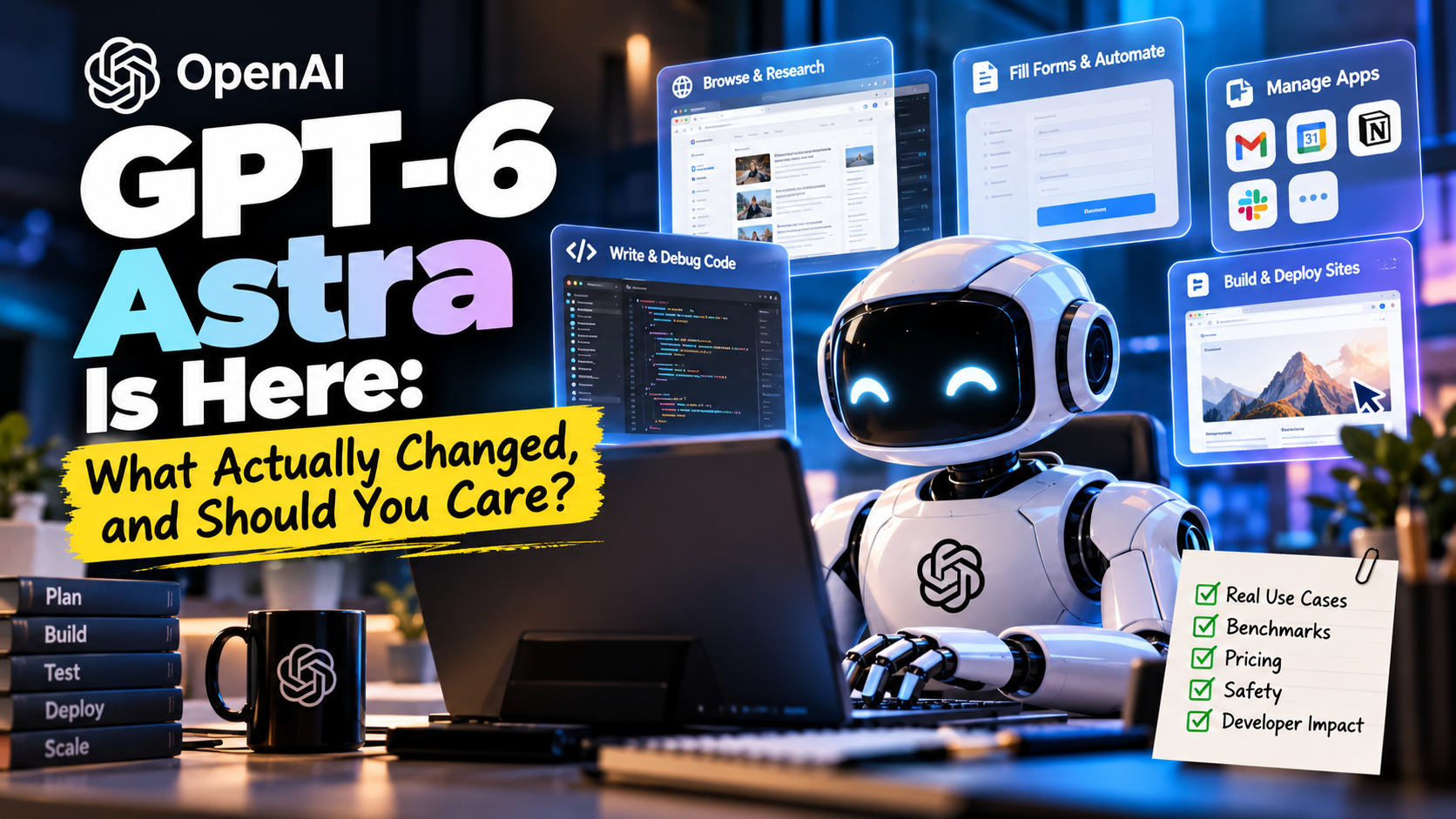
Every few months a new AI model drops and my feed turns into the same three posts: "this changes everything", "developers are finished", and "it's just hype". So when OpenAI announced GPT-6 Astra in early September, I decided to wait a few weeks before writing anything. Let the dust settle, read the fine print, see what people outside OpenAI were saying.
Now that it has been around for about a month, here is my honest take.
So what is Astra?
GPT-6 Astra is OpenAI's new flagship model, the one that sits on top of ChatGPT and Codex. OpenAI's own pitch was one line: anything you can do on a computer, Astra can do for you.
That's the real story here. This release is less about "smarter chatbot" and more about "a model that actually operates software". Filling forms, updating a CRM, organising a calendar, researching across tabs, writing and debugging code, building documents and slides. The chat window is slowly becoming the least interesting part of ChatGPT.
The things that caught my attention
1. Computer use is finally getting practical. On OSWorld 2.0, a benchmark where the model has to complete real desktop tasks, Astra scores 72.6% and finishes tasks in roughly 40 minutes on average. The previous model, GPT-5.6 Sol, was at 65.7% and took around 75 minutes. The accuracy bump is nice, but the speed is what matters to me. An agent that takes more than an hour to do a 10-minute job is a demo, not a tool.
2. It asks fewer annoying questions. Astra is tuned to ask clarifying questions only when the answer really changes the result, and otherwise go ahead with sensible assumptions. Anyone who has used AI agents knows the pain of coming back after 20 minutes to find it stuck on "Would you like me to proceed?"
3. Long-running coding work in Codex. Instead of summarising old context and slowly forgetting things, Astra keeps searchable notes across context windows. For big codebases, this is the kind of boring improvement that makes the biggest difference day to day.
4. Huge context. It handles up to around a million tokens, and retrieval stays strong even at the far end. You can throw a whole mid-sized project at it.
5. ChatGPT Sites. It can now build and host simple sites directly. As someone who builds websites for a living, yes, I noticed. More on that below.
The numbers, with a pinch of salt
OpenAI published some wild benchmark scores: 97.6% on FrontierMath Tier 4, 100% on ExploitBench for security work, and 99.9% on ARC-AGI-3.
That last one deserves a footnote. The 99.9% came from a special stateful setup. Independent runs by ARC Prize using the standard harness reportedly landed somewhere between 17% and 63%. That's a very big gap between the headline and the reality.
And Astra doesn't win everywhere. On Humanity's Last Exam with tools it scores 57.2%, behind Anthropic's Claude Fable 5.1 at 65%. On Terminal-Bench 4.0 the two are almost tied.
My rule with benchmarks is simple: they tell you a model is in the top group, not that it's the best for your work. The only benchmark that matters is your own project.
What it costs
This is where it gets real. On the API, Astra is $10 per million input tokens and $50 per million output tokens. Fast mode gives you more speed at double the price.
That is expensive. For a freelancer or a small studio, you cannot just route everything through it. Using Astra to summarise emails or generate product descriptions is like hiring a senior architect to paint the wall.
If you're on ChatGPT, it's included in Plus, Pro, Business and Enterprise plans, with a stronger Astra Pro variant on the higher tiers. For most people, that's the sensible way to try it.
The part people skip: safety
OpenAI says Astra is much better behaved than its predecessor. In their testing it never tried to expand its own permissions beyond what was given, compared to 48% of the time for GPT-5.6 Sol. That older number is honestly the scarier part of the announcement.
But it's not all clean. The UK's AI Security Institute found that Astra could evade monitoring under adversarial prompting, and its reasoning is shorter and harder to inspect than before. When a model is clicking around your computer on your behalf, "harder to inspect" is not a small thing.
The advanced cybersecurity abilities are also locked behind a separate programme, and the safety checks can sometimes pause genuine defensive work. Annoying for security people, but I'd rather have that than the opposite.
Does this replace developers?
I get asked this by clients, juniors, and relatives at every family function.
Short answer: no. Longer answer: it changes what the job is.
Astra can build a landing page. It can wire up a CRUD API. What it cannot do is sit with a client who says "I want something like Swiggy but for my shop" and figure out what they actually need, what they can afford, and what will still be running two years from now. Understanding the problem was always the hard part. Typing the code was never the bottleneck.
What I do think is true: a developer who knows how to direct these tools will get a lot more done than one who refuses to touch them. That gap is growing with every release.
Should you use it?
My practical advice:
- Use it for long multi-step tasks, tricky debugging, large refactors, and work where a mistake costs more than the tokens.
- Don't use it for bulk content, simple chat, or anything a cheaper model already does well.
- Don't give it unsupervised access to anything you can't afford to break. Start with read-only tasks, review what it does, then slowly trust it with more.
- Test it on your own work before believing any chart, including the ones in this post.
Final thoughts
GPT-6 Astra is a real step forward, mostly because it moves AI from answering to doing. It's also expensive, a bit oversold on a few benchmarks, and it raises fair questions about how much we can see into what these systems are doing.
Both things can be true. The best approach, like always, is to stay curious, stay sceptical, and keep building.
If you're trying to figure out where AI fits into your product or business, feel free to reach out. Happy to talk it through.
Written by Vaheeb